Is the Government Listening to Your Phone Calls?

President Trump’s recent tweet claiming President Obama tapped his phone has caused many to ask, is the government be spying on me?

Three Thing to Know

  • While it is absolutely feasible for your calls to be intercepted by the U.S. government, that doesn’t mean they are — at least not on purpose. Still, it doesn’t mean you shouldn’t worry.
  • Foreign governments, hackers, and crooks might listen to your calls using malware to compromise your phone.
  • There are steps you can take to foil the bad guys such as encrypted calling apps and good old-fashioned common sense.

Not Without a Warrant (in theory)

The U.S. government has vast signals intelligence capabilities, but by law it cannot intentionally listen in on U.S. persons without a warrant. To eavesdrop on your calls, the government would first need a warrant. To get it, they’ll need to persuade a judge that probable cause exists that you’ve committed a serious crime. Or, if they suspect you are an agent of a foreign power, they can also get what’s called a FISA warrant from the Foreign Intelligence Surveillance Court. Recently, legislative reforms further restricted federal surveillance powers and the NSA’s bulk metadata collection. However, the government routinely eavesdrops on foreigners’ phone calls. If your call is to a foreign national, especially one of interest to our intelligence services, there’s a chance the government could be listening. This is probably how they knew about the calls between Michael Flynn and Russian Ambassador Sergei Kislyak. It may also be the source of reports of calls between Russians and associates of Donald Trump. However, US intelligence agencies are supposed to do their best to ignore your side of the conversation. The law requires that they follow “minimizationprocedures intended to protect the privacy of Americans. Minimization procedures generally require intelligence agencies to redact  references to U.S. persons from any reporting.

Somebody Else Might Be Listening

Foreign governments, on the other hand, could care less about your privacy and have no such need for warrants. Their capabilities to intercept calls are probably more limited, at least within the U.S. But, abroad it’s a whole different story. If you’re traveling overseas, it’s not unreasonable to assume your call might be intercepted. Even if your call isn’t picked-up over the air, hackers, governments and other bad guys could still tap your conversation using malware. Malicious software can allow the bad guys to not only listen to your calls, but essentially look over your shoulder. Some malware will allow a hacker to see and hear everything you do on your phone. They can log everything you type, including your passwords, and even turn your phone into a remote listening post, transmitting audio and video back to a bad hombre on the other end.

How You Can Protect Yourself

To be safe, you can use an app like Signal that encrypts calls and texts. So, long as your phone itself isn’t compromised, anyone who intercepts your call will get only gibberish. If you’re careful, you can make it far less likely your phone is hijacked. Keep your phone’s software updated. Updates often contain security fixes that patch vulnerabilities that hackers could take advantage of. Be very careful about clicking on odd links or email attachments, even if it looks valid. Even if an email looks valid, appearing as though it is from say your bank or your email provider, asking you to click a link, don’t do it. Those links could install spyware or capture your password if you use the link to log in. Instead, open your browser and access the web site directly. This technique, known as “spearfishing,” was how Russian hackers were able to compromise Hillary Clinton’s campaign chairman John Podesta’s email. Even if you have no reason to suspect the government is spying on on you, it’s still a good idea to take precautions. Hackers trying to steal your credit card number or your identity use some of the same techniques. A connected world, as marvelous as it is, means you have to be a little more careful too.

Here’s Four Reasons Obamacare Repeal is Turning Out to Be So Hard

0
Repealing Obamacare is hard. President Obama’s health care overhaul, more formally known as the Affordable Care Act, is a tangled web of interrelated mandates, regulations and taxes. Tinkering with any one of them can have a domino effect with unpredictable consequences. President Trump and Republicans want to keep parts of it that are popular, like the guarantee that people with pre-existing conditions can still get coverage. But, that’s not as simple as it seems.

1) Keeping Everyone Covered

Repealing Obamacare while keeping its guarantee that those with pre-existing conditions will be covered is one big reason repealing Obamacare is difficult. Health insurers are reluctant to cover people with a history of major health problems because the costs of their care are likely to vastly outstrip the premiums they pay in. If there are too many sick people relative to healthy people in an insurance risk pool, there’s not enough money to pay for everyone’s care. Obamacare sought to solve this by mandating that everyone buy health health insurance and by providing a subsidy for poorer people to help pay for it. It was hoped that this would mean more young, healthy people less likely to get sick paid premiums leaving enough money left over to provide care for all the people with pre-existing conditions. It didn’t quite go as planned. Premiums have soared, rising 25% on average this year. There are a number of reasons for this, but two big ones are that not enough healthy people bought plans and the ones that did were more expensive to care for than expected. Insurers were forced to hike premiums to fill the gap.
Just 28% of people enrolled in Obamacare exchanges in the cheaper to care for 18-34 age range, far below the estimated 40% level needed.
The GOP Obamacare repeal plan takes a different approach. It would do away with the mandate to buy coverage and replace Obamacare’s subsidy with a tax credit that offsets the cost of buying insurance.
Unlike a tax deduction, which reduces the income on which a person is taxed, a tax credit directly reduces a person’s tax bill directly.
Unlike the Obamacare subsidy, the tax credit proposed by Republicans would vary from $2,000 to $4,000 based on age, rather than income. The richest tax credits would be reserved for people 60+ years of age who face the largest premiums. The GOP hopes that this tax credit, when combined with reductions in costly regulatory red tape, more flexibility, and other reforms will encourage more people to get coverage and reduce overall health care costs.

2) Medicaid Expansion

Obamacare offered states the option to expand Medicaid, with the federal government picking up much of the tab. If that money goes away, the thirty-one states took the feds up on the offer would either have to deny coverage to people who gained coverage under the expansion or cough up enough money to pay for it themselves. So, lawmakers from expansion states want to see this part of Obamacare stay in place. Lawmakers from states that didn’t expand don’t think they shouldn’t have to foot the bill for the states that did. The Republicans’ plan would end Medicaid expansion in 2020, after which the program would undergo dramatic changes. Currently, Medicaid is administered by states under rules set by the Federal government, sharing the costs between them. After 2020, states would get a fixed lump of cash from Washington based on how many people they have enrolled. States could then use that money with few strings attached, allowing states to design their own Medicaid plans that best fit their population. The plan will also establish a $100 billion fund to help with the transition.

3) Paying for It

Obamacare imposed a variety of big tax increases on everything from rich people to tanning salons. The Republican bill repeals most of these taxes, but punted on the thorny question of how to replace the lost revenue. For example, the largest of these, a $158 billion tax on wealthy Americans and investors, would stay in place through 2018. Fiscal conservatives are worried that this could result in a massive explosion in the deficit.
Source: Joint Tax Committee, Tax Foundation
With roughly $575 billion in taxes set to get the ax, this is not an insignificant problem that must be worked out eventually.

4) The Politics are Complicated

If Republicans all stick together, there are enough votes to put this bill on President Trump’s desk. But, that’s a big if. The bill obviously faces universal oppositions from Democrats and from both wings of the Republican caucus. Some conservatives are deriding it as “Obamacare Lite,” a reshuffling of the Obamacare deck chairs disguised as repeal. Yet, more moderate members (mostly those from states that did not expand Obamacare) aren’t unified in support either because they may lose Medicaid dollars. Stitching all these competing interests together will require someone with extraordinary dealmaking skills. America elected just such a person the 45th President of the United States, Donald Trump. Whether Trump can put pull it off will be the first real test of whether they made the right call. Follow Taylor Griffin on Twitter: @tgriffinNC Photos reproduced under Creative Commons 2.0 license.

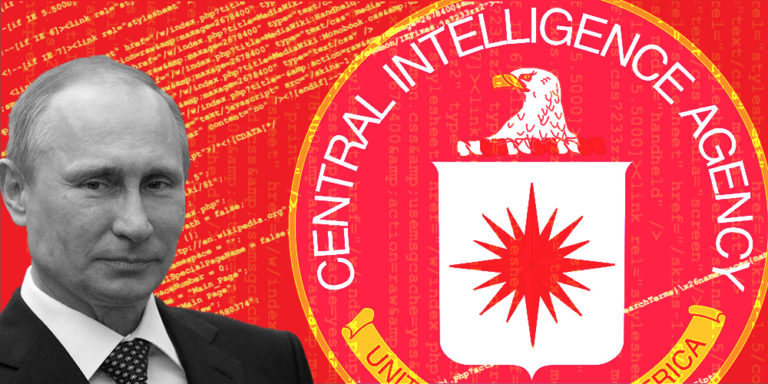
Could Russia Be Behind the Wikileaks Dump of CIA documents?

Three Things to Know

  • A trove of stolen CIA documents released by Wikileaks this week included a catalogue of malware developed by other countries, including Russia, that Wikileaks claimed could facilitate “false flag” attacks that appear as though they were carried out by another country.
  • Predictably, Kremlin-controlled web sites and conspiracy theorists lost no time touting this as “evidence” that the CIA, not Russia, hacked the DNC.
  • This leads some to speculate that Russia, who has the most to gain from shifting suspicion away from itself, could be behind the Wikileaks dump this week.

False Flags

Perhaps the biggest news to come out the Wikileaks dump of thousands of pages of purported Central Intelligence Agency documents about the agency’s hacking operations isn’t that it has the capabilities to turn phones and TV sets into microphones. Cybersecurity experts have known about that for years. The big news was a Wikileaks tweet that the CIA can conduct “false flag” attacks using malware embedded into computers. A false flag attack is one in which the instigator diverts suspicion to another country or entity. According to Wikileaks, a collection of malware employed by other countries could facilitate such attacks by leaving forensic fingerprints that point investigators towards, say, Russian intelligence agencies rather than Langley.
@Wikileaks: “CIA steals other groups virus and malware facilitating false flag attacks”
As the Daily Dot noted: “All of this immediately gave rise to a new conspiracy theory: the CIA must have hacked the Democratic National Committee itself and blamed Russia. The website Sputnik International, which is owned and operated by the Russian government, was happy to entertain this theory, as was the ‘citizen journalism’ website Russia Insider, which asserted that any evidence of hacking that points to Russia ‘must now be dismissed as either fake or meaningless.’” And maybe that was the point of the Wikileaks dump – to sow confusion and point fingers for the DNC hack and other attempts to influence the 2016 elections at the CIA rather than Russia. This is all speculation, but there are multiple signs that suggest Russia could be behind both the DNC hack, and the Wikileaks dump as well.

Russia’s Long History of ‘Active Measures’ Operations

For half a century, Russian intelligence agencies have conducted on-and-off operations aimed at disrupting Western democracies known as “active measures.” In the intelligence community’s report on Russian influence in the 2016 elections, the former Director of National Intelligence (DNI) James Clapper noted: “During the Cold War, the Soviet Union used intelligence officers, agents of influence, forgeries, and press placements to disparage candidates perceived as being hostile to the Kremlin . . .” Starting under President Putin – who it should never be forgotten is a former KGB officer – the Russians expanded that effort to include cyber warfare in the former of hacking, leaking hacked files and phishing operations against government officials, political figures, journalists and think tank executives. Clapper stated, “By their nature, Russian influence campaigns are multifaceted and designed to be deniable because they use a mix of agents of influence, cutouts, and false-flag operations.” The Russians did not just try to influence the 2016 elections (whether they did or not is something that only history can determine), but they also did so during the 2014 Ukrainian crisis. Russian intelligence service likely are involved in this year’s French and German elections as well. Witness the false reports in Russian media about German women being raped by refugees, or the near daily drip of news stories about scandals that affect the French far right and right presidential candidates, neither of whom would not be hospitable to the Kremlin.

Nothing New

Matthew D. Green, a cryptology expert at Johns Hopkins University told the Washington Post, “The idea that the CIA and NSA can hack into devices is kind of old news. Anyone who thought they weren’t was living in a fantasy world.” Green’s right. There have been numerous press reports about the potential for devices hooked up the Internet, including baby monitors, being converted into covert listening posts. It can be assumed that these are all vulnerabilities of which a sophisticated state intelligence service could take advantage.

The NSA demonstrated this possibility in a 2011 cybersecurity briefing to congressional staff meant to convince staff traveling overseas of the need for security. An NSA official, using his laptop, secretly activated an iPhone in the audience to record the presentation and play it back to the astonished of staffers. It was a dramatic way of showing the way the devices can be used to spy on the owner.

Why Some Suspect Russia Nicholas Weaver, a computer security researcher at the University of California at Berkley, was quoted in the Washington Post as saying that the CIA documents “were taken in February or March 2016.” That date is very significant. The reason is that, according to Clapper, “The General Staff Main Intelligence Directorate (GRU) probably began cyber operations aimed at the US election by March 2016.” This bears repeating: The CIA documents were handed over to Wikileaks at precisely the same time the Russians started their campaign to influence the elections. Ties between Russia and Wikileaks have long been suspected. Susan Hennessy, a former NSA lawyer now at the Brookings Institution said, “There is a lot of circumstantial evidence of the links between Assange and Russia. It’s certainly not a coincidence that Russian military intelligence selected WikiLeaks as a distribution platform for its Democrats hack.” Clapper again: “We assess with high confidence that the GRU [Russian military intelligence] used . . . Wikileaks to release” information “obtained in cyber operations [hacks] publicly and in exclusives to media outlets.” The DNI reports that “Moscow most likely chose Wikileaks because of its self-proclaimed reputation for authenticity . . . . The Kremlin’s principal propaganda outlet RT (formerly Russia Today) has actively collaborated with Wikileaks.” Those who choose to believe that Wikileaks is not in bed with Russian intelligence agencies, should consider that among the first people to vouch for the Wikileaks was none other than Edward Snowden, who intelligence officials strongly believe is a Russian agent. In a tweet issued within hours of the Wikileaks dump Snowden, who is now living in Moscow, said what the documents were “genuinely a big deal. Looks authentic.” Wikileaks was heavily involved in Snowden’s case as well. One of the people who helped Snowden escape to Russia was Sarah Harrison, a Wikileaks editor. “When the U.S. charged him under the Espionage Act . . . an extradition order was sent to Hong Kong,” an article in Vogue notes. “But it came too late: Before anybody made a move to capture him, Edward Snowden—led by Sarah Harrison—had quietly boarded a flight to Moscow and basically vanished.”

The ‘Deep State’ Plot

James Lewis, senior vice-president at the Centre for Strategic and International Studies and an expert on cyber security, speculated to The Guardian that the motive behind the leak could be to underpin the false flag narrative of the Trump camp. “This might be one explanation for the leaks – it’s data to build a case that the Russian interference and connections are a secret ‘deep state’ plot, as the false flag bits in WikiLeaks ‘shows’” Lewis said. Why else would Russian intelligence want to dump thousands of pages of CIA documents onto the Web? A clue may be found in a throw-away paragraph of a Washington Post article: “The FBI has spent years investigating Wikileaks, and authorities are eager to figure out whether it has recruited a well-placed source from the U.S. government.” A former intelligence official was quoted as saying, if the Wikileaks documents came from the CIA, “there’s going to another major mole hunt.” People unfamiliar with CIA history will ask what does the unnamed intel official mean by “another?” James Angleton ran the CIA’s counter espionage program. A CIA publication about Angleton notes that, starting in the 1960s and for roughly the next 10 years, he “embarked on counterproductive and sometimes harmful efforts to find moles [within the CIA] . . .” To put it more bluntly, Angleton tore the agency apart. Perhaps there were two purposes behind the Wikileaks tweet: First to throw suspicion of the source of the DNC hack off the Russians and onto the CIA; and, second, to have the CIA and other U.S. intel agencies chase their tails for years in a mole hunt while the Russians and their allies do what they want. — The author is a former U.S. government investigator.

The Story Behind Trump’s Claim that Obama Tapped His Phone


NOTE: An earlier version of this story stated that a FISA warrant was received by the FBI. There is conflicting reporting on this point. The story has been updated to more accurately reflect this uncertainty.
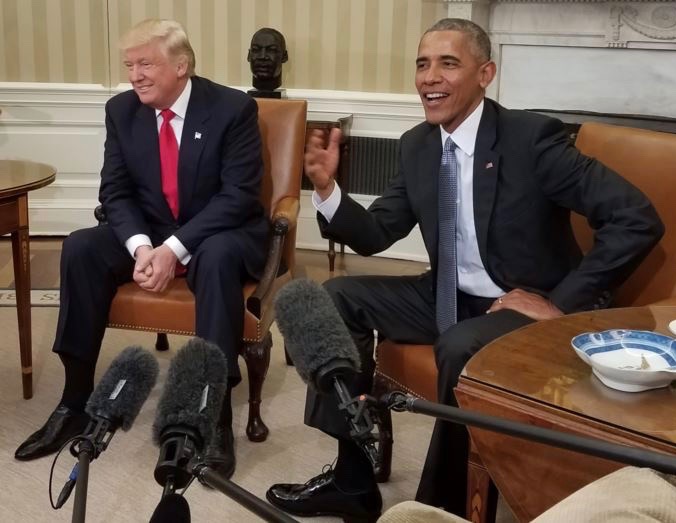
In a series of tweets Saturday morning, President Donald Trump took to Twitter to accuse his predecessor of tapping his phone in the month leading up to the election. “How low has President Obama gone to tapp[ing] my phones during the very sacred election process,” Trump tweeted. “This is Nixon/Watergate. Bad (or sick) guy!”

Five things you need to know

  • While it is highly unlikely that President Obama personally ordered anyone to tap the phones in Trump tower, the FBI has been actively pursuing several overlapping investigations that relate to connections between Trump confidants and Russia.
  • Any communications between Trump associates and Russian officials would almost certainly have been intercepted as part of the U.S. intelligence community’s routine monitoring of Russian intelligence officers and government officials. No action would have been required of Obama. 
  • Stories in the British press have reported that the FBI sought, and apparently received, a FISA warrant. Caution is warranted. American news outlets have never been able to corroborate the British reporting and there are other reasons to doubt this as well.
  • Even if there was a FISA warrant, it would not have targeted Trump directly. Even the British reports do not support the claim that it targeted phones in Trump tower. Rather, the British stories claim it focused on the activities of two Russian banks and the peculiar behavior of a computer server registered to the Trump Organization.
  • The complexity and arcane processes governing national security investigations provide fertile conditions for conspiracy theories. Presidents do not have the power to unilaterally order wiretaps on U.S. persons. If Obama did specifically order a wiretap targeting Trump, it would be a scandal of epic proportions. However, from what we know, there’s no evidence to suggest he did.

A Suspicious Server and a ‘Silent Coup’

Trump’s tweet-storm coincides with the publication of a Brietbart story reportedly making the rounds in Trump world on Friday. In it, radio talk show host Mark Levin outlined what he said was a silent “silent coup” plotted by President Obama in the closing days of his administration to undermine his successor. Based on the publicly available evidence, Levin’s theory is  far-fetched. The truth is probably far less dramatic. And, at the center of the story is (drumroll please) yet another email server.
Julian Sanchez has an excellent post sorting through Levin’s arguments over at Just Security.
The White House says that Trump’s tweet was based on several articles, most of which are also cited by Levin.  The most significant (and controversial) of these is a November article by Louise Mensch, of Heat Street, a British news site. According to Mensch’s report, “the FBI sought, and was granted, a FISA [Foreign Intelligence Surveillance Act] court warrant in October…after evidence was presented of a server” registered to the Trump Organization “and its alleged links to two banks; SVB Bank and Russia’s Alfa Bank. This should be viewed cautiously, well-sourced U.S. journalists who have been covering this story every day have as yet not been able to corroborate this report.  The FBI’s interest was piqued late last spring when a group of academic computer scientists reviewing Domain Name Server (DNS) logs, a sort of central address book that helps internet traffic find its way around the web, noticed something strange in the DNS requests coming from a disused server registered to the Trump Organization. It seemed to be communicating almost exclusively with two servers registered to Russian-based Alfa bank. It wasn’t necessarily nefarious, but it was odd. Considering that around that same time, in June of last year, cybersecurity researchers concluded that the Russian government had been behind attacks on the DNC’s email system, it was alarming enough to investigate further. According to a BBC report, the FBI is said to have sought the warrant “to intercept the electronic records from two Russian banks.” The order, the BBC story claims, targeted foreign entities rather than President Trump or his associates directly.

“Their first application, in June, was rejected outright by the judge. They returned with a more narrowly drawn order in July and were rejected again. Finally, before a new judge, the order was granted, on 15 October, three weeks before election day. Neither Mr Trump nor his associates are named in the FISA order, which would only cover foreign citizens or foreign entities – in this case the Russian banks. But ultimately, the investigation is looking for transfers of money from Russia to the United States…”

The New York Times, which has not reported that a FISA warrant was involved. According to the Times, after examining data from the server the FBI determined that the servers’ odd behavior might be explained by something more innocuous, like a misaddressed email bouncing back and forth between the servers.

Careful Denials

President Obama and former administration officials deny that there was any FISA warrant issued targeting Trump or his staff. Appearing on NBC’s Meet the Press Sunday, former Director of National Intelligence James Clapper said that, speaking for the intelligence community, there was “no wiretap activity mounted against the president, the president-elect at the time, or as a candidate, or against his campaign.” Clapper confirmed that if the FBI had received such an order, he would have been aware of it. 

Former President Barack Obama’s spokesman Kevin Lewis also denied Trump’s accusation. “A cardinal rule of the Obama Administration was that no White House official ever interfered with any independent investigation led by the Department of Justice,” Lewis said. “As part of that practice, neither President Obama nor any White House official ever ordered surveillance on any U.S. citizen. Any suggestion otherwise is simply false.” 

Presidents do not have the power to unilaterally order a wiretap on Trump, or any U.S. ‘person.’ Even if there had been a wiretap order on Trump’s phones, it would be requested by the attorney general rather than the president. A wiretap requires first obtaining a warrant from a Federal judge. To do so, the government must demonstrate that there is probable cause that the target of the wiretap has committed a serious crime or, in the case of FISA warrants, is an agent of a foreign power.

Trump’s Phones Weren’t Tapped; but the Russians’ Were

No credible source, including the ones cited by the White House, assert Trump’s phones were tapped. Trump can rest easy. Unless…

Any conversations with Russian officials would be intercepted as part of the routine surveillance that U.S. intelligence agencies conduct on Russian government officials. There would be no need for Obama to tap Trump’s phone to pick-up conversations with Russians, the Russians’ phones are almost certainly being listened to anyway. Clearly conversations between Trump’s former National Security Advisor Michael Flynn and Russian Ambassador Sergei Kislyak were monitored. However, there are strict FISA “minimization procedures” restricting how such incidental collections of conversations involving U.S. persons could be used. David Kris of Lawfare provides a good explanation of how this applied in the Flynn case:

“It is certainly true that U.S. intelligence services can get orders from the Foreign Intelligence Surveillance Court to monitor foreign officials. The Russian ambassador, simply by virtue of his nationality and official position, is an “agent of a foreign power” under FISA and hence a valid target for wiretapping. It is publicly known and acknowledged that the U.S. government uses FISA to wiretap foreign embassies and consulates…

“…In some cases, when an intelligence agency issues a report based on a wiretap, minimization requires the issuing agency to substitute a generic reference in place of a U.S. person’s name—e.g., ‘Ambassador Kislyak said that he was looking forward to watching the Grammy Awards on television and that he was hoping that [U.S. Person] would win an award.’ [Intelligence reports aren’t always exciting as you think.]

“But a U.S. person’s name can be used when it is necessary to understand the foreign intelligence information in the report, and no serious argument can be made that Flynn’s identity was not necessary to understand the intelligence significance of his call with Ambassador Kislyak.”

 Political Jujitsu

Attorney General Jeff Sessions’ recusal last week represented only the latest maddening drip in a Chinese water torture inflicted by a string of Russia-related revelations that keep knocking the legs out from under White House denials. While nothing has emerged so far that provides conclusive evidence of any wrongdoing, memories of Trump associates seem to get unusually hazy when it comes to their dealings with Russia. Judging by how often Trump aides have been forced to clarify their statements, team Trump must feel more misunderstood than a teenage goth listening to Morrissey on repeat. The White House’s preferred tactic – deny it all as fake news and attack the media – has been in a losing battle with real news of late. Turning the tables on Obama puts Trump back on the familiar conspiratorial ground he happily plowed for many years with his birther claims. Whether intentional or not, President Trump’s accusation is a brazen feat of political jujitsu. In turning the tables on Obama, he shifts the debate and puts himself back on offense. Defending a claim that, however preposterous, is nearly impossible to prove untrue is much easier than disputing facts that are staring everyone in the face.  

What You Need to Know About Jeff Sessions’ Recusal

Thursday, Attorney General Jeff Sessions recused himself from the ongoing investigation into supposed links between Trump campaign staffers and Russian intelligence officers and officials. The announcement came after the Washington Post reported that Sessions had met with Russian Ambassador Sergei Kislyak last year, seeming to contradict statements he had made in is confirmation hearing. Here’s what you need to know

Q: Why did Sessions say he had no communications with the Russians when it now seems he had?

It appears that Sessions was answering a question with the context of his role with the campaign in mind. He wasn’t asked directly rather he personally met with Russians. Rather, he was asked about the broader question of the campaigns communications with Russia by Sen. Al Franken (R-MN). Here’s precisely what he said:
FRANKEN: “CNN just published a story alleging that the intelligence community provided documents to the president-elect last week that included information that quote, ‘Russian operatives claimed to have compromising personal and financial information about Mr. Trump.’ These documents also allegedly say quote, ‘There was a continuing exchange of information during the campaign between Trump’s surrogates and intermediaries for the Russian government.’ “Now, again, I’m telling you this as it’s coming out, so you know. But if it’s true, it’s obviously extremely serious and if there is any evidence that anyone affiliated with the Trump campaign communicated with the Russian government in the course of this campaign, what will you do?” SESSIONS: “Senator Franken, I’m not aware of any of those activities. I have been called a surrogate at a time or two in that campaign and I didn’t have — did not have communications with the Russians, and I’m unable to comment on it.”
Russian Ambassador Sergey Kislyak, Photo Credit: (NASA/Joel Kowsky)
Sessions’ spokeswoman Sarah Isgur Flores told the Washington Post that Sessions met with the Russian ambassador in his capacity as a senator, not as a Trump campaign surrogate. “He was asked during the hearing about communications between Russia and the Trump campaign — not about meetings he took as a senator and a member of the Armed Services Committee,” Flores said. The response that has caused all the trouble was information Sessions volunteered. It seems unlikely that Sessions, a lawyer by training, would perjure himself unnecessarily. Further, one of the meetings took place in Sessions’ Senate office where it was unlikely to go unnoticed. This all suggests that Sessions may have simply answered the wrong question. In a news conference Thursday, Sessions said his comments at his confirmation hearing were “honest and correct as I understood it at the time.”

Q: Why did Sessions recuse himself?

“I have decided to recuse myself from any existing or future investigations of any matters related in any way to the campaigns for president of the United States.”  – Attorney General Jeff Sessions
While Jeff Sessions’ mistake may have been innocent, in light of all of the other recent revelations about Trump campaign contacts with Russia it doesn’t look good. Sessions’ position on Trump’s campaign makes a continued role in the investigation untenable. Calls for him to recuse himself would have continued to mount. If he refused to do so, it might allow a perception that there was a cover-up.

Q: Who will handle the case going forward?

The case will simply be handled by Sessions’ Acting Deputy, Dana Boente. According to the Department of Justice’s statement on the matter, “Acting Deputy Attorney General and U.S. Attorney for the Eastern District of Virginia Dana Boente shall act as and perform the functions of the Attorney General with respect to any matters from which I have recused myself to the extent they exist.” Mr. Boente is a career civil servant who was appointed by President Barack Obama as the United States attorney for the Eastern District of Virginia. He became acting attorney general after President Trump fired Sally Q. Yates for her refusal to defend Trump’s immigration executive order. Q: Does Sessions have backing from senior Republicans? At this point, probably yes. Assuming that the meetings were truly unrelated to the campaign, the fact that Sessions met with the Russian Ambassador isn’t particularly significant. Q: What does all this mean to the Trump Administration? It is another data point, albeit perhaps an innocent one, in what is a growing amount of smoke surrounding alleged connections between Trump associates and Russia’s active measures related to the 2016 election campaign. The steady stream of leaks about Russian connections is draining Trump’s political capital and complicating his ability to move forward his agenda. It may also make it more politically difficult for Republicans facing a re-election challenge in next year’s mid-terms to defend him. https://prodroughlyexp.wpengine.com/2017/02/trump-russia-smoke-mirrors-fire/ Q: What are the chances of Sessions keeping his job as Attorney General? Very good. If the only issue is two meetings with Russian Ambassador Sergei Kisylak unrelated to Russia’s active measures operation in the 2016 campaign then it is very likely that Mr. Sessions will maintain his post. However, if there was collusion between the Trump campaign and Russia that Sessions was a party to, his position may quickly become untenable.    

The Oscar Speech We Want to Hear (but probably won’t)

Increasingly political awards show speeches could benefit from a little understanding. Here’s the speech we wish we’d hear at the Oscars tonight. We’re not holding our breath.
“Like many of you, I am unhappy with last year’s election results and concerned about the direction our president is taking the country. But at the same time, it is time to acknowledge that I – we, those of us in this room – missed something fundamental going on in this country. “So while I will continue to oppose this president and many of his policies, I’m committing myself to listening – really listening – to those who supported him, certain in the knowledge that we have more in common than not.
“It’s still a fact that most of us in this country want a place where we can chase and achieve our dreams, create a good life and opportunity for our families, and recognize that through diversity comes our great strengths. That was true when boatloads of European foreigners arrived at Ellis Island in the early days of the 20th Century, and it’s true today when planes from London and Istanbul and Kabul arrive at LAX or JFK, carrying people who’ve taken the many long, hard steps it takes to qualify for citizenship here. “We all pay taxes, we all live in the same place, a place that is truly great. But we can and must do better. That’s the essence of America, and being an American – always striving for improvement. “So let’s all of us seek out those who think differently from us on some issues, humble in our understanding that neither we, nor they, have all the answers. “Finally, I’d like to thank my mom, my dad, my producers, my co-stars for helping me achieve this great honor. Because in filmmaking, like in life, we never achieve anything all by ourselves.
Richard Keil is a former White House correspondent for Bloomberg News and national reporter for the Associated Press. Keil is currently Executive Vice President at public relations firm H&K. Follow him on Twitter @RDKeil1

re: The President’s Debt Tweet

0

For the classes I teach at Stanford’s Graduate School of Business I make my students write policy memos to a friend or family member as if that person was a Member of Congress. I have done the same here. These memos are similar in style to those I used to write for President George W. Bush and Senate Majority Leader Trent Lott. Here’s a pdf version.


Stanford 25 February 2017 MEMORANDUM FOR A MEMBER OF CONGRESS FROM:           KEITH HENNESSEY SUBJECT:      THE PRESIDENT’S DEBT TWEET You asked whether you should echo or retweet President Trump’s tweet about declining debt. In a word, no. It appears the president was repeating something Herman Cain said this morning on Fox & Friends Weekend. We know the president watches this show and his tweet appeared shortly after Mr. Cain was on-air. The numbers are technically correct.
  • Debt held by the public declined $19.6 B from January 20, 2017 to February 23, 2017, the most recent day for which data is available.
  • In 2009 the same measure increased $222.6 B (more than the “$200 billion” the president cited) over the same timeframe.
But government cash flows are lumpy, leading to big daily fluctuations in government debt.
  • Had the president / Mr. Cain ended his timeframe one day earlier this tweet would have been invalid and debt would have increased (by just $1 B) in “the first month.”
  • This is why analysts look at debt on an annual basis rather than daily/weekly/monthly.
Neither president affected government borrowing in his first month.
  • Government borrowing in January and February is the byproduct of spending and tax policies set by Congress the year before. President Obama signed the fiscal stimulus law on February 17, 2009, but it took months before that began to change government cash flows and borrowing requirements. President Trump has so far not measurably affected fiscal policy in general or government borrowing in specific.
  • It’s unfair to assign any responsibility for borrowing in the first month to either president.
The big difference between early 2009 and now is the health of the economy.
  • GDP was plummeting when President Obama took office. Tax revenues were down, automatic stabilizer payments (e.g., unemployment insurance and safety net spending) were up, and funds were being spent from the Troubled Asset Relief Program (TARP). In early 2009 government was borrowing a lot because the economy was weak, not because of President Obama’s policies.
  • In contrast, the U.S. economy is now growing. The smaller borrowing requirement for this month is mostly a result of this economic difference, and may also in part be simply an artifact of choosing such a short timeframe for comparison.

Recommendation

Because of his unique communications advantages, President Trump may be able to get away with making an argument with such a weak foundation. You cannot, and you should not place yourself in the position of having to address the intellectual weaknesses described above. More concerning, this tweet shows the president continues to rely on TV rather than his advisors for numbers and policy substance. Until his staff figure out a way to ensure he doesn’t make such easily rebutted claims, you should not echo the president’s economic arguments or claims without first verifying both their accuracy and substantive merit. This is particularly true of his early morning and late night tweets, when he’s probably in the residence and away from his staff. This unfortunate situation will persist as long as President Trump continues to take his numbers and policy arguments from TV pundits rather than from Mr. Cohn, Director Mulvaney, and Secretary Mnuchin. Keith Hennessey teaches economic policy at Stanford’s Graduate School of Business and served as Director of the National Economic Council for President George W. Bush.

Originally published at keithhennessey.com on February 25, 2017.

Trump’s War on the Media Enters a New Phase

0
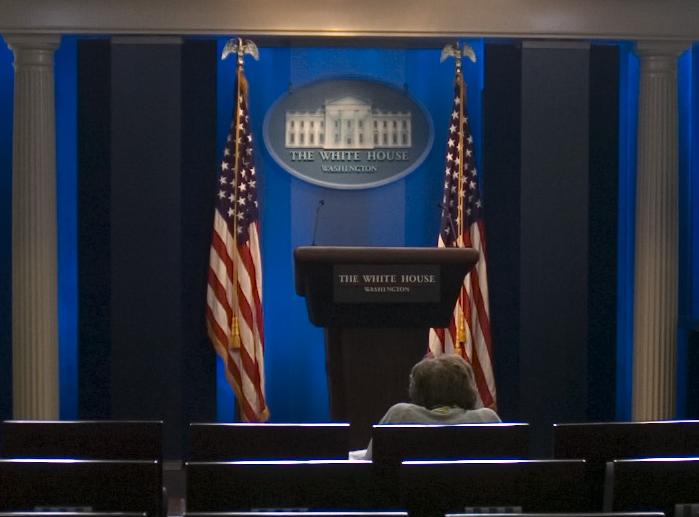
Many Americans who pay any attention to politics have probably wondered, “What the heck is a gaggle?” since White House Spokesman Sean Spicer on Friday deliberately excluded several news organizations from a pen-and-pad briefing that abruptly took the place of the previously scheduled televised daily briefing. The gaggle kerfuffle proceeded to dominate headlines and air time for much of Friday as the latest example of the increasing contempt with which the Trump administration holds CNN, The New York Times, The Los Angeles Times, Politico, Buzzfeed, the BBC, The Guardian, some of which he has previously dubbed “fake news” and “enemies of the people.” At the same time, the White House went out of its way to include conservative outlets Breitbart, One America News, and The Washington Times in the gaggle, which was also attended by a variety of other mainstream publications that haven’t (yet?) attracted the president’s ire for tone and tenor of their coverage. A few news organizations including the Associated Press boycotted the briefing in solidarity with the excluded journalists. The blowback was swift. New York Times editor Dean Baquet called the hand-picked briefing audience unprecedented. The National Press Club – the only venue willing to host the “Deploraball” on Inauguration weekend — called the action “unconstitutional censorship.” But Spicer defended his decision, saying the White House would continue to “aggressively push back” on “false narratives, false stories, inaccurate facts” he alleges the news organizations in question have perpetrated.

Briefings, Gaggles and Pools

There’s a lot to unpack here, but understanding the different types of press availabilities at the White House (and for that matter, most of official Washington) is a critical first step. Most people have watched the press secretary’s daily briefing. That is typically held in the afternoon around 2 p.m. and has been televised live on a more or less routine basis since the Clinton administration, usually on cable news/CSPAN. That press briefing has become highly ritualized with reporters peacocking and press secretaries reciting talking points. Until this year, they rarely made news of their own accord. More to the point, nearly anyone claiming to be a journalist can attend the briefing by getting a daily pass approved by the Secret Service; the briefing famously attracts interesting characters of all ideological persuasions. The gaggle is different. Typically, it is off-camera and also called a “pen-and-pad” although reporters usually record it for note-taking purposes. A gaggle can occur anywhere – the press secretary almost always holds one with pool reporters on Air Force One before arriving at a destination, for example. During the Clinton and Bush administrations, there were also daily gaggles held in the morning before the televised briefing (I am told the Obama administration did away with this practice). These sessions typically are held inside the press secretary’s office, which is located behind the briefing room, down the hall from the Oval Office. They served as an opportunity for reporters to get a first glimpse of the day from the press secretary. But they also gave the press secretary an early indicator of what stories reporters are chasing. Good press secretaries did two things with this information – they gave information and answers to the reporters for their early stories and began refining their talking points for the televised briefing later. Among other types of groupings, there are two types of “pools.” The first is formed when space is limited, with pool reporters obliged to share all information from whatever event they cover with the entire press corps. The second is the traveling pool, which limited to the number of seats on Air Force One and includes the wire services, photographers and rotating television, magazine, radioo and newspaper representatives. Being a permanent member of this pool requires extensive financial resources as the government bills the news organizations proportionately for air travel and other costs. Finally, there are “backgrounders” and other less formal press availabilities with the president and senior aides. Participating in these events is by invitation and inherently selective – oftentimes journalists don’t find out they were excluded until after the fact. No fuss is made because there is no expectation, implicitly or explicitly, of collective access, like there is for press briefing or daily gaggle.

What to Make of it All

Friday’s controversy erupted in part because of confusion and differing interpretations over these structures. Spicer’s availability originally was scheduled as a briefing. Then it was abruptly called a gaggle. Spicer later defended it as an “expanded pool.” Former White House Spokesman Ari Fleischer, alluding the “backgrounder” category of grouping, accused the press of “hyperventilating” because previous presidents, including Obama, have often been selective about which members of the press to engage. The difference here is the retaliatory nature of the exclusion. It’s true that while the First Amendment guarantees freedom of the press, it does not guarantee access to the president or his spokesman, however punitively excluding journalists working in a public building funded by taxpayers is a slippery slope. Spicer himself in December acknowledged that barring access is “something a dictator does.” There is also the fact that this is just the latest in a sustained attack by Trump that appears aimed at delegitimizing established news organizations that are most aggressively investigating his policies and activities while simultaneously attempting to legitimize outlets viewed as sycophantic and don’t subscribe to professional journalism standards codified by the Society for Professional Journalists and the National Press Club. Ultimately, the gaggle kerfuffle is a distraction and red herring. For Trump, it rallies his base (which isn’t the same thing as the conservative base — many staunch conservatives are deeply concerned about the treatment of the press as well). More importantly, it has news organizations navel gazing about how they’re being treated. The number of TV hours, column inches and journalism resources to this incident comes at the expense of deeper coverage/investigation of other important developments. The biggest is the revelation that White House Chief of Staff Reince Preibus asked the FBI to “push back” against reports that Trump aides had extensive contacts with Russian intelligence officials (news of which catalyzed the exclusion from the gaggle in the first place.). But it can be argued other developments merited more coverage, including sussing out the administration’s response to North Korea’s willingness to use chemical weapons like VX in a crowded airport for an assassination and the ongoing developments with Trump’s immigration policies. Instead, these stories are being pushed off the proverbial front page by journalists forced to cover themselves, something that in and of itself violates a long-standing tenet of the trade. Now that Trump has sought to exclude some press from his press secretary’s briefings, his next step will be to exclude himself: He announced late Saturday that he won’t attend the White House Correspondents Dinner
Ryan Donmoyer was a White House reporter from 2001-2005 for Bloomberg News.

READ MORE

https://prodroughlyexp.wpengine.com/2017/02/trumps-war-on-the-press/

The Year That Truth Died

0

Among the most striking developments of 2016 was the extent to which politics came to be defined less by which policies we advocate, but which facts we believe. Political discourse has increasingly run aground over disagreements about what is and is not true before even reaching the substance of issues. The competition of ideas that makes democracy work is becoming an endangered species.

Donald Trump’s supporters see Russian election hacking as a hoax promoted by the left and their allies in the media to discredit his victory. Meanwhile, Hillary Clinton’s partisans are convinced that Russia’s hacking not only happened, it delivered him the election. Both are wrong. Russian hacking probably did happen, but it’s not the reason Trump won. Because neither side can reach agreement on what reality actually is, they cannot reach meaningful consensus on what to do about it either.

The rise of fake news and Donald Trump’s sometimes counterfactual rants, both on and off Twitter, have received a lot of ink. Yet, they are mostly symptoms of larger trends that are slowly killing truth. The economics of digital media is driving a proliferation of increasingly sophisticated clickbait designed to press our political buttons. Social media algorithms and news sources that cater precisely to our political preferences are creating ideological bubbles that expose us only to content that reinforces our pre-existing beliefs regardless of veracity. Media bias, real and perceived, is eroding trust in mainstream news sources. But, the lion’s share of the blame can be placed on our own intellectual laziness and unwillingness to consider information that challenges our assumptions.

There is a strong case that, in America and elsewhere, there is a shift towards a politics in which feelings trump factsmore freely and with less resistance than used to be the case. Helped by new technology, a deluge of facts and a public much less given to trust than once it was, some politicians are getting away with a new depth and pervasiveness of falsehood. If this continues, the power of truth as a tool for solving society’s problems could be lastingly reduced. — The Economist

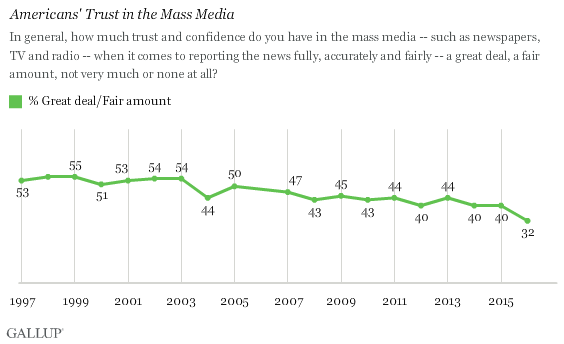
free and independent press is democracy’s natural defense mechanism against the proliferation of nonsense. But, declining trust in mainstream news has rendered it impotent as an impartial arbiter of truth. Less than a third of Americans (32%) now trust mainstream media, the lowest level recorded since Gallup began tracking it in 1972.

Gallup, “Americans’ Trust in Mass Media Sinks to New Low,” Sept. 14, 2016.

Some of this erosion of trust in media is self-inflicted. Facing stiff competition from a new breed of edgier news sources like Breitbart, BuzzFeed and Vox, old-line news outlets increasingly prioritize conflict, yawn at consensus, and present complex issues in ways more likely to provoke.

While mainstream news has long given conservatives justifiable reason to complain of biased news coverage, 2016 took it to a whole new level. Politicians, including Donald Trump, must be held accountable. But, they must be held to an equal standard. Yet, to paraphrase Orwell, when it comes to the media’s approach to Donald Trump some are more equal than others.

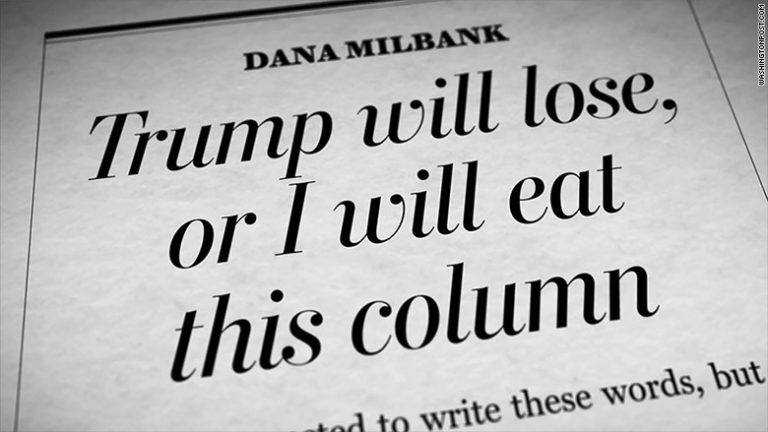
An alien descending to earth would be hard pressed not to conclude that mainstream news outlets were pulling for Hillary to win. The near universal disdain for Trump on editorial pages and front pages alike is hard to miss. Revelations of cozy relationships between Hillary Clinton’s campaign and reporters further confirmed the suspicions of many conservatives (and Bernie Sanders supporters too) that the media was in the tank for Hillary. The media’s unanimous dismissal of Trump having any chance at victory appears in hindsight suspiciously like wishful thinking.

Even after the election, media outlets continue to hold Trump to an inconsistent standard. For example, Trump’s recent refusal to accept daily intelligence briefings was met with resounding condemnation in the press, yet a few years earlier, news outlets defended President Obama when he was criticized for the same thing.

Reflecting the view of many in the news business, New York Times media columnist Jim Rutenberg wrote back in August that when journalists believe that Trump is a danger to the Republic “you have to throw out the textbook American journalism has been using for the better part of the past half-century.” Carolyn Ryan, The New York Times’s senior editor for politics, told Rutenberg that Trump’s candidacy is “extraordinary and precedent-shattering…to pretend otherwise is to be disingenuous with readers.” Rutenberg concludes that “[i]t may not always seem fair to Mr. Trump or his supporters. But journalism shouldn’t measure itself against any one campaign’s definition of fairness.”

When the media can no longer be depended upon as an objective arbiter of truth, differing versions of reality widen partisan gaps and destroy common ground upon which political leaders can find compromise.

While there is much about Donald Trump that is worthy of scrutiny, in their zeal to expose Trump’s flaws journalists have too often seemed to drop the veneer of journalistic objectivity altogether. The inconsistent standard the media apply to Donald Trump not only infuriates his supporters, it justifies them in the belief that nothing in the press can be trusted. And that is a problem.

A free press that can be trusted to distinguish fact from fiction is crucial to the proper functioning of democracy. When one thing is unfair or untrue, it is reasonable for people to assume that everything else might be too. Trust in media breaks down, fake news can flourish and politicians can lie without consequence. When the media can no longer be depended upon as an objective arbiter of truth, differing versions of reality widen partisan gaps and destroy common ground upon which political leaders can find compromise. In short, democracy breaks.

Fake-ish News

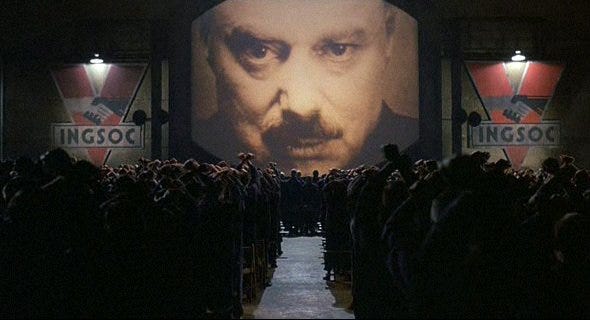
Some fringier media outlets are taking things a step further. A story is making the rounds of the internet, complete with foreboding images evocative of George Orwell’s 1984, about a provision “buried deep within” the annual military funding bill recently signed by President Obama that purportedly creates a “de facto Ministry of Truth.”

SOURCE: ZeroHedge.com

ZeroHedge.com declares that it “marks a further curtailment of press freedom and another avenue to stultify avenues of accurate information.” But, once the layers of hyperbole are peeled back, this is wildly misleading.

The truth is far more pedestrian. The provision established a “Global Engagement Center” at the State Department to coordinate various programs aimed at countering foreign propaganda such as the State Department’s public diplomacy functions and U.S. information services like Voice of America. The Center is directed at addressing the growing use of disinformation by foreign adversaries, not manufacturing propaganda aimed at the American people.

Nothing in the provision that was just signed into law would “[curtail] press freedom and…stultify avenues of accurate information.” Quite the opposite. The objective is to expand access to accurate, independent sources of information in response to foreign efforts to spread disinformation.

A more sober, factual version of the story is, however, unlikely to get much traction online. Dressed up in Orwellian clothes it is catnip for those pre-disposed to believe Barack Obama an aspiring tyrant. The version of the story posted on ZeroHedge.com has already racked up 59,000 shares and counting. By polluting the internet with grossly distorted interpretations of facts, it is ironically posts exactly like this that actually “stultify avenues of accurate information” far more than any Global Engagement Center ever could.

The overwrought hysteria about Obama’s “Ministry of Truth” is emblematic of a trend of disingenuously repackaging real news to enhance its viral qualities and, it is hoped, draw traffic that can be sold to advertisers.

The objective is not to inform, but to attract eyeballs and hold them long enough to convert them into revenue.

It’s not “fake news” per se, but a close cousin that contains enough truth to appear credible, while clothed in enough hyperbole to attract the clicks, likes and shares to make it go viral. Call it “fake-ish news.” The objective is not to inform, but attract eyeballs and hold them long enough to convert them into ad revenue.

Content providers may argue that this is just good business. But, it is also having a real impact on democracy. Whether we need another layer of bureaucratic coordination for U.S. public diplomacy programs and how appropriate government programs aimed at influencing oversees audiences are to begin with is a matter of legitimate debate. But, by blurring the lines between the real issue and the canard of a dystopian Ministry of Truth, “fake-ish news” ensures ensures that this a debate we will not have.

It is not just fringe blogs that play the “fake-ish” news game. Revenue starved traditional media outlets also sometimes manipulate news in subtle ways that, while not technically inaccurate, evoke provocative if erroneous assumptions.

Recently, CNN published a story online with the headline “Saddam Hussein’s daughter: Trump has ‘political sensibility’”

The interview with Hussein’s eldest daughter Raghad, was mostly a reflection on her father’s rule and the Iraq war. There is little to no news value in what the daughter of a long-dead dictator thinks of Donald Trump. It is the headline mostly because it is coming from someone called Hussein, a name long tagged with pariah status. Right-leaning internet trolls use Barack “Hussein” Obama’s full name for the same reason. By referencing Hussein’s views on Trump, it is sure to get some shares among progressives. It is an editorial decision that while defensible, appears to be less about news and more about traffic.

As one Tweet cracked: “I know when I need to know more about Trump Saddam’s daughter is the first person that comes to mind. I wonder what Hitlers kin think?”

Economic Pressures Mount

These sorts of tactics may be a sign to things to come. As the financially troubled news industry seeks to shore up wobbly balance sheets, increasing their share of the digital advertising pie is critical. News outlets are increasingly dependent on digital ad revenue, by far the fastest growing advertising segment. A quarter of newspaper revenues came from digital last year. That is a huge jump from the 5% of newspaper ad revenue that came from digital a decade ago.

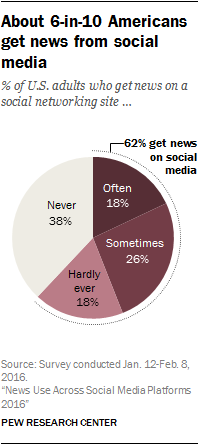
Attracting larger audiences increasingly means luring people away from social media platforms like Facebook and Twitter where they spend the vast majority of their time online. According to a study published earlier this year, 6 in 10 Americans get news from social media and that number is certain to grow. News outlets have strong incentives to present content that entices people to click by playing up angles likely to invoke strong partisan reactions.

It’s not just Macedonian teenagers and Russian hackers that are corroding the inner-workings of Democracy. The very same media outlets that have been contemptuous about fake news are also sometimes guilty of a tamer version of the same thing.

The Solution is Up to Us

None of this is good for democracy. As content providers get better at enticing us to click on their websites, news media blurs the lines of journalistic objectivity, and social media locks us into partisan bubbles, we get worse at doing our jobs as citizens and voters.

There is no magic fix. A lot of the solution is up to us. Truth might not be completely dead. It is still possible to gain some reasonable measure of truth, it just takes more work.

  • Accept that media bias exists, but don’t assume that everything you see is the product of it. Reading more than one source on the same topic helps add context and separate fact from biased conjecture.
  • Be wary of outlandish conspiratorial claims, especially those that appear on obscure websites that deluge you with ads. Do some research and apply some common sense before accepting these claims as fact and sharing them on social media.
  • Make a concerted effort to seek out smart opinions contrary to your own and consider them with an open mind. At worst, you’ll have greater reason for confidence that your point of view is correct.

The availability of vast quantity of information in the 21st century equips us with better tools than anyone in history to determine what is true, but only if we choose to use them.

The abundance of information also has a darker side that can make it harder to distinguish fact from fiction. More information means more bogus, misleading and downright deceptive information too. If we seek only justification for our beliefs, we will surely find it, even if what we believe is wrong.

Dmitry Kiselyov, the Kremlin’s propagandist-in-chief, declared in a recent interview with The Economist that this means “[t]he age of neutral journalism has passed. It is impossible because what you select from the huge sea of information is already subjective.” Let’s all make it a point to prove him wrong.

Judging from the sorry state of political discourse in this country, the darker side is winning. That is more of a threat to democracy than a thousand Russian hackers. Unless we put in the effort to see the world objectively and understand contrasting points of views, it is impossible to make the rational political decisions required of citizens in a democracy.

It is uncomfortable to confront facts that challenge our deeply held views. But, our republican system of government only works when we have the courage to do so.


NASA Discovers Seven New Earths

0
Look up this evening towards the constellation Aquarius and you may be looking at another Earth — seven of them in fact. NASA announced this week that the Spitzer space telescope has found seven earth-sized planets orbiting a small, dim star closely enough to allow for liquid water. Three of the planets are within the so-called “habitable zone,” the area around a star most likely to support life.
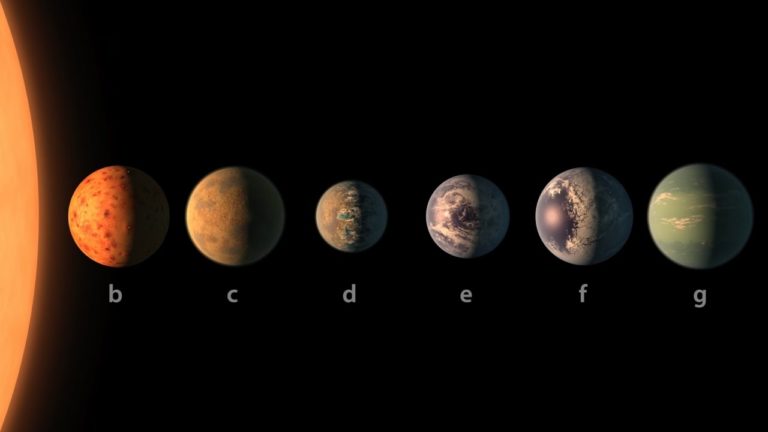
All seven planets discovered in orbit around the red dwarf star TRAPPIST-1 could easily fit inside the orbit of Mercury, the innermost planet of our solar system. CREDIT: NASA/JPL
The TRAPPIST-1 system, named for the the Transiting Planets and Planetesimals Small Telescope (TRAPPIST) that first identified three of the planets last spring, offers the greatest opportunity yet to determine if life exists beyond Earth. “This discovery could be a significant piece in the puzzle of finding habitable environments, places that are conducive to life,” said Thomas Zurbuchen, associate administrator of the agency’s Science Mission Directorate in Washington. “Answering the question ‘are we alone’ is a top science priority and finding so many planets like these for the first time in the habitable zone is a remarkable step forward toward that goal.”
The TRAPPIST-1 star
The TRAPPIST-1 star, an ultra-cool dwarf, has seven Earth-size planets orbiting it. This artist’s concept appeared on the cover of the journal Nature on Feb. 23, 2017.
Credits: NASA/JPL-Caltech
TRAPPIST-1, at 40 light years away, relatively close to us. It’s star is substantially cooler than the earth, allowing planets very close to it to still be cool enough to allow liquid water. The next step will be further analysis of the chemical components of their atmosphere to determine whether the basic building blocks of life, principally water, exist on the planets. NASA will be following up with further study with the Spitzer, Hubble, and Kepler space telescopes in advance of the upcoming James Webb Space Telescope, launching in 2018, which will be able to observe the TRAPPIST-1 system with far greater sensitivity. Webb, according to NASA, “will be able to detect the chemical fingerprints of water, methane, oxygen, ozone, and other components of a planet’s atmosphere. Webb also will analyze planets’ temperatures and surface pressures–key factors in assessing their habitability.” The newly discovered planets, known as exoplanets, are closely grouped. Close enough together in fact that standing on the surface of one of the planets, the other nearby planets would be easily visible, appearing larger than the moon in the sky.
This illustration shows the possible surface of TRAPPIST-1f, one of the newly discovered planets in the TRAPPIST-1 system. Scientists using the Spitzer Space Telescope and ground-based telescopes have discovered that there are seven Earth-size planets in the system.
“This is the most exciting result I have seen in the 14 years of Spitzer operations,” said Sean Carey, manager of NASA’s Spitzer Science Center at Caltech/IPAC in Pasadena, California. “Spitzer will follow up in the fall to further refine our understanding of these planets so that the James Webb Space Telescope can follow up. More observations of the system are sure to reveal more secrets.” The discovery promises the possibility that the question of whether the miracle of life is unique to Earth could be answered within our lifetimes.